

Thanks for visiting my blog! MudBay World Wonders was created as an addendum to MudBay Musings as my personal way of celebrating God's magnificent creation by posting interesting stories and facts about our complex world.


Showing posts with label bird. Show all posts

Sunday, May 16, 2010

The Superb Lyrebird

 
photo of male Superb Lyrebird: copyright Hans and Judy Beste

Lyrebirds are ground-dwelling Australian birds, most noted for their ability to mimic natural and artificial sounds from their environment.  A lyrebird's call is a mixture of its own song and imitations of other songs and sounds. The bird's syrinx (vocal organ) is the most complexly-muscled of any songbird, giving the lyrebird the extraordinary ability to imitate almost any sound, including: various songbirds, flocks of birds, musical instruments, chainsaws, jackhammers, machinery of all kinds, car engines, car alarms, explosions, rifle-shots, fire alarms, camera shutters and motor drives, barking dogs, crying babies and the human voice. There are two species of lyrebird: the Superb Lyrebird and Albert's Lyrebird.
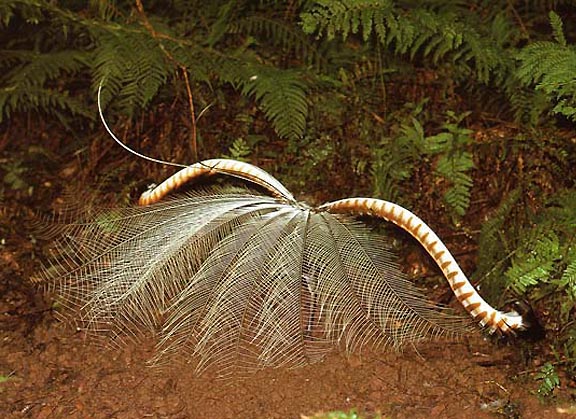

photo of male Superb Lyrebird: copyright Hans and Judy Beste

Cool Superb Lyrebird Facts:
  • The lyrebird is able to carry on two tunes at the same time
  • Males construct and maintain an open area mound in dense bush, on which they sing and dance in courtship
  • Females build an untidy nest close to the ground in a moist gully
  • Females lay a single egg and incubate the egg for over 50 days
  • When in danger, lyrebirds run rather than fly due to their awkwardness in flight
  • Lyrebirds have been seen to take refuge in wombat burrows, and firefighters taking shelter in mine shafts during bush fires have been joined by lyrebirds
  • A group of lyrebirds is called a musket
  • When in display, the male lyrebird's tail is carried up over his back as a shimmering fan, not in an upright lyre-shaped fashion
  • The female lyrebird lacks the elaborate plumes of highly modified tail feathers
photo of male Superb Lyrebird: Wikipedia Commons

Amazing Video Links:
For a video of "Chook" at the Adelaide Zoo imitating construction work, click here .
For a video of David Attenborough observing a lyrebird's repertoire in the wild, click here.


photo of male Superb Lyrebird: copyright by Ryan Wick, Creative Commons

Saturday, May 1, 2010

He's Got the Blues !

Sometimes, you run across animal behavior that makes you smile. Such is the life of the male Satin Bowerbird.  He's a bit unassuming at first glance...
But he has a few tricks up his wing!  It seems this particular species of Bowerbird has a love for all things blue..  In the wild, he would normally gather blue berries and pebbles for his bachelor's bower... but times have changed.  Due to the decline of their natural habitat and recent close proximity to people, the birds have begun to collect - even steal - from trash cans, picnic grounds, and neighboring backyards.  One man's trash truly is another bird's treasure.

The Bowerbird constructs an elaborate nest, or bower, which he then adorns with items of his own choosing... items he hopes the ladies will find irresistible.  Different species of Bowerbirds decorate with items indigenous to their region and habitat, and the sizes of their bowers vary from species to species.

 This fellow sure has been working hard to collect his impressive blue treasure trove...

Perhaps he chose blue to match her striking blue eyes...

Whatever his reasons, she seems impressed! 

For more information about these intriguing birds, check out this wonderful video narrated by David Attenborough.

A Few Bowerbird Facts:
  • There are 17 species of Bowerbirds in Australia in New Guinea
  • Each species builds its own shape of bower and prefers a different decorating theme
  • Items found in bowers include: moss, twigs, feathers, coins, straws, key chains, bottle caps, aluminum foil, flowers, pebbles, charcoal, small toys, shells, nails, glass, rifle shells, and even a glass eye.
  • Satin Bowerbirds paint the walls of their bowers with "chewed" berries or charcoal
  • The male Bowerbird constantly rearranges his treasures, fine-tuning his masterpiece
  • Young male Bowerbirds often steal treasures from their more experienced rivals